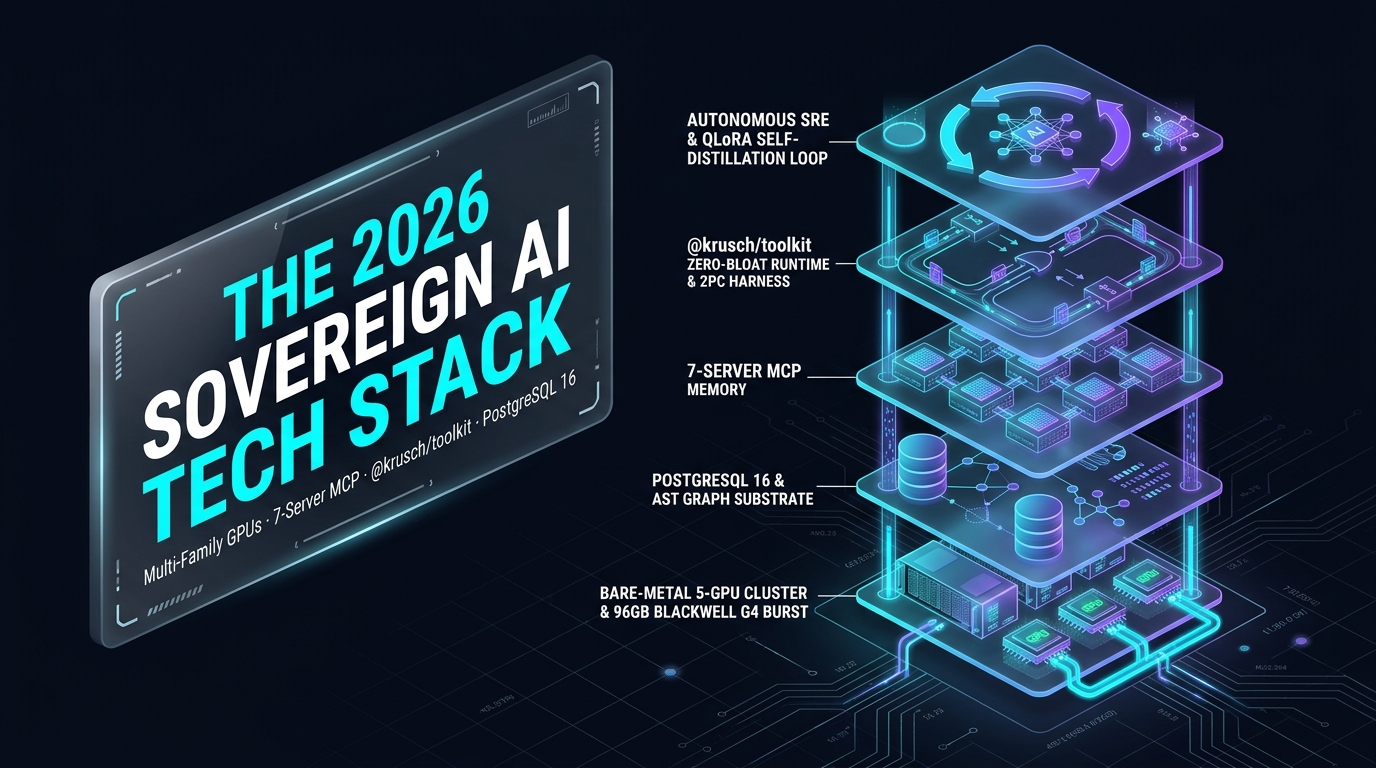
snowflake-arctic-embed2 vector plane, a 7-server Model Context Protocol (MCP) substrate backed by PostgreSQL 16 and SQLite WAL, a zero-bloat shared monorepo runtime (@krusch/toolkit & krusch_toolkit), import-frozen policy floors, and 24/7 autonomous SRE sweeps that distill test-verified fixes into open-weights QLoRA + DPO adapters—all packaged into a one-command installer (krusch-stack).
1. Why We Reject the Default 2026 AI Wrapper Stack
Across 28 active core repositories and 88 audited software targets in our monorepo, one empirical rule dominates: probabilistic models fail predictably when forced to act as their own router, database, memory manager, policy engine, or code auditor.
Where conventional stacks paper over stochasticity with longer system prompts, our platform enforces hard systems boundaries:
- Multi-Family Model Isolation over Single-Vendor Monoculture: When a Qwen model writes code and another Qwen prompt reviews it, correlated pre-training blind spots slip into production. We isolate distinct model families across distinct physical GPU nodes so no model family ever grades its own homework.
- Microsecond CPU & Logprob Routing over LLM-as-Router Tax: Burning 500ms of frontier inference just to classify an intent is an architectural bug. Our cascade router resolves syntactic patterns in
<15µson CPU ($0.00), routes semantic queries via8KArctic centroids, and aborts degenerate streams live via SSE logprob gates—ranking #1 on RouteWorks RouterArena CI (0.7883/80.72%at$0.21/1K) and #1 Pareto (0.4269,-83.95%cost) across12,566ACL 2026LLMRouterBenchprompts. - Relational Graphs & Multi-Scale Memory over Flat Chunks: Arbitrary 500-token chunking severs AST symbol scopes, statutory preemption DAGs, and PDF bounding boxes. We store Git DAGs, AST caller/callee edges, OS page trees, and hierarchical episodic rollups in PostgreSQL 16 +
pgvectorHNSW and SQLite WAL, indexed with 8,192-tokensnowflake-arctic-embed2asymmetric vectors. - Import-Frozen Policy Floors & Shared Zero-Dep Toolkits: Every Node.js 22 ESM and Python 3.12 service imports from a single monorepo library (
@krusch/toolkit&krusch_toolkit), executes mutations behind non-bypassable policy floors and 2PC sandboxes, and ships via a single command (npx krusch-stack init).
┌─────────────────────────────────────────────────────────────────────────────────────┐
│                   THE 2026 KRUSCHDEV SOVEREIGN AI TECH STACK                        │
│     Unified Installer: `npx krusch-stack init` (--defer-tools) | `docker compose`   │
├─────────────────────────────────────────────────────────────────────────────────────┤
│ PILLAR V   · AUTONOMOUS SRE & SELF-DISTILLATION (Jean SRE · 88 Targets · QLoRA+DPO) │
│              Argon + 120B Teacher ──(18,131 SFT+DPO Rows)──► 30B Student + 8B Edge  │
├─────────────────────────────────────────────────────────────────────────────────────┤
│ PILLAR IV  · HARNESS POLICY FLOORS, SPEC-FIRST & PARALLEL SUBAGENT ORCHESTRATION    │
│              Frozen spec.md ──► Disjoint Subagents ──► Referee + Verify-on-Stop     │
├─────────────────────────────────────────────────────────────────────────────────────┤
│ PILLAR III · ZERO-BLOAT RUNTIME & TOOLKITS (@krusch/toolkit · krusch_toolkit)       │
│              Node 22 ESM (node:sqlite, oxlint) · Python 3.12 · Embeddings · Raw-RAG │
├─────────────────────────────────────────────────────────────────────────────────────┤
│ PILLAR II  · 7-SERVER MCP SUBSTRATE (`krusch-stack` · 39 Verbs / 9 Upfront BM25)    │
│              Tier 1: krusch-context v2.0 │ Tier 2A: krusch-git │ Tier 2B: krusch-fs │
│              Tier 3: krusch-harness 2PC  │ Domain: Gateway · Frontend · G-Krusch    │
├─────────────────────────────────────────────────────────────────────────────────────┤
│ PILLAR I   · MULTI-FAMILY 5-GPU BARE-METAL + 8K ARCTIC + 96GB BLACKWELL G4 BURST    │
│              L0 (<15µs CPU) ──► L1/L2 Local 5-GPU Pool (57GB+ VRAM · 10GbE Fabric)  │
│              ──► L2.5 Blackwell G4 (gpt-oss:120b) ──► L3 Frontier (Gemini 4 Argon)  │
└─────────────────────────────────────────────────────────────────────────────────────┘
2. Pillar I: Multi-Family 5-GPU Local Compute + 96GB Blackwell G4 Burst Topology
Our compute plane operates as a 5-tier latency and capability cascade across an 8-node bare-metal Linux cluster interconnected over a dedicated 10GbE fabric, an ephemeral SSH cloud GPU burst tunnel, and frontier multimodal escalation.
A. The Bare-Metal 5-GPU Local Pool (100% GPU-Resident, keep_alive: -1)
Every local model is pinned 100% in VRAM with keep_alive: -1, q8_0 quantized KV caches, and zero-CPU-spill guards—eliminating cold-start reload thrash across interactive coding sessions and 24/7 background daemons:
| Compute Tier / Node Role | Hardware Profile | Pinned Models & KV Geometry | Architectural Responsibilities |
|---|---|---|---|
| Node-02 · Heavy Compute Host 10GbE Compute Plane |
Dual Xeon 40T · 64GB ECC Dual RTX 2080 Ti (22.5GB NVLink) |
qwen3-coder-30b-moe:latest( 16,384 ctx · q8_0 KV · 124.2 tok/s) |
Primary local code synthesis, multi-file AST refactoring, and 24/7 Jean SRE autonomous persona sweeps across 88 targets. |
| Node-01 · State & Referee Host 10GbE Production Plane |
Dual Xeon 40T · 80GB RAM Dual RTX 3060 (24.5GB VRAM) + Dedicated NVMe DB Array |
gemma4:e4b (16K ctx · native tools/thinking/vision/audio)hermes3:latest (16K ctx · q8_0 KV)snowflake-arctic-embed2:latest (8K ctx · 1,024-dim) |
Cross-Family Referee Pool (auditing Qwen outputs), SRE tool executor, statutory/contract prose, secondary embedding pool, and primary PostgreSQL 16 + pgvector HNSW host. |
| Node-03 · Orchestrator Host Central Control Plane |
i7-5820K · 32GB RAM RTX 2080 Ti (11.2GB VRAM) |
snowflake-arctic-embed2:latest (8,192 ctx · 1,024-dim · 664MB VRAM)qwen2.5-coder:7b (16K ctx · 74.6 tok/s)faster-whisper (base.en 16kHz ASR) |
Fleet-wide 8K-context asymmetric (query:) semantic embedding engine (89.17% Macro Recall@1 vs. 82.79% legacy 512-ctx bge-large across 119K+ active vectors), sub-second tag router, local IDE coding, and real-time voice ASR. |
| 5 Specialized Edge Nodes Tailscale + LAN Mesh |
Surface Kiosk, Mobile Auditor, Sandbox Worker, Media/Backup & Staging Nodes | Zero-daemon SSH targets & lightweight SQLite/DBOS workers | Touch/voice companion & wall-hub dashboards, isolated sandbox verification, media processing, and encrypted off-node backups. |
| Tier L2.5 · On-Demand Cloud Burst SSH Loopback Tunnel |
48 vCPU · 176GB RAM NVIDIA RTX PRO 6000 Blackwell (96GB VRAM) |
gpt-oss:120b( 131,072 ctx · ~117.7 tok/s · 4-bit MXFP4) |
Provisioned via CLI for 120B architectural audits, closed-system long-context BEAM / Polyglot / RepoBench-R / LegalBench-RAG benchmarks, and Dual-Track QLoRA fine-tuning; auto-stopped to 0.00 CU/hr on session close. |
| Tier L3 · Frontier Escalation Multimodal & Deep Reasoning |
Managed Frontier API + CLI (gemini-api v0.4.3) |
gemini-4-argon (65,536 max output · thinkingLevel · CONTINUATION)gemini-3.1-flash-lite |
L0 specification synthesis, 3-viewport headless Chrome visual UI auditing (375/768/1440px), and Golden Remediation teacher traces. |
B. Cross-Family Referee Consensus: Why No Model Grades Its Own Homework
When qwen3-coder-30b-moe on Node-02 proposes a patch or audit finding, verification never routes back to a Qwen model. Instead, @krusch/toolkit's runRefereeAuditPass and evaluateRefereeConsensus dispatch the candidate diff and frozen specification to gemma4:e4b and hermes3:latest on Node-01 (or gpt-oss:120b / gemini-4-argon for L0 refactors). Orthogonal pre-training corpora and tokenizer geometries break self-reinforcing hallucination loops before any diff reaches disk.
3. Pillar II: The 7-Server MCP Ecosystem, Hermetic Benchmarks & Deferred Tool Loading
Dumping 80+ sprawling MCP schemas into every turn bloats prompt prefixes and degrades tool selection. We partition our operational surface into 7 focused MCP servers—each enforcing compact verb contracts (350–450 tokens), explicit 4-boolean MCP annotations (readOnlyHint, destructiveHint, idempotentHint, openWorldHint), token-budget ceilings (limit_tokens), and space-isolated 8K snowflake-arctic-embed2 vectors:
| MCP Server | Tier / Domain | Verb Contract | Storage, Benchmarks & Key Invariants |
|---|---|---|---|
krusch-context-mcpv2.0.0 (82★) |
Tier 1 Working Memory & Invariants |
5 Verbs:retrieve, remember, revise, nudge, health |
node:sqlite WAL + Porter FTS5 + Two-Level Episode Rollups + 2-Hop Gram-Schmidt Residual Bridges (<5ms, 0 RPCs) + attribute-level epistemic grounding + PG16 dual-write. Validated closed-system across all 2,000/2,000 Official ICLR 2026 BEAM (100K–10M, ~178.34M tok) probes: 92.58% 100K & 93.00% 10M IE recall, zero E2E drop to 1M (72.86%), beating cloud past.dev on CR (4/4 splits) & 10M MSR. Enforces Turn-1 Hydration & INV-12 SHA-256 drift checks. |
krusch-gitv1.2.3 |
Tier 2A AST & Git DAG Substrate |
7 Verbs:search_symbols, dependency_graph, file_symbols, semantic_search, read_tree, read_blob, list_repos |
PostgreSQL 16 + pgvector HNSW + stemmed tsv GIN. Multi-language AST chunker (JS/TS/Py/Go/Rust/Java) with live cursor import-activity analysis (analyzeImportSymbolActivity), oversampled HNSW/GIN CTEs (252ms → 15.25ms across 54,456 symbols), and 2-hop graph bridging. Ranked #1 (56.40% 10-Task Macro NDCG@10, 73.88% Recall@10) across all 2,389,123 docs & 162,216 queries of ACL 2025 CoIR and 19.12% Macro Acc@1 (68.58% Acc@5) across 47,998 RepoBench-R queries—beating CodeBERT & UniXcoder. |
krusch-fs-mcpv0.3.1 |
Tier 2B 8-Node OS Page Memory |
6 Verbs:search, locate, page_tree, read_page, remember_on_page, sync |
SQLAlchemy SQLite WAL / Postgres + KruschNexus Library Mode. Indexes PDFs, DOCX, /etc/systemd, and /etc/fstab across 8 SSH nodes with compact 4,096-byte IEEE-754 float32 vector blobs (-19% DB footprint), Porter FTS5, SHA-256 PageMemory drift checks, and pre-write secret-leak shielding. |
krusch-harnessv0.1.0 |
Tier 3 Staged 2PC Execution |
7 Verbs:run, task_status, diff, apply_diff, explain, reject, abort |
PostgreSQL 16 state machine + Bubblewrap (bwrap) sandboxes (108/108 tests + 100/100 Golden DAG CI). Enforces import-frozen policy floors, truncation-poisoning breakers, verify-on-stop outer loops, and <32ms 2PC apply journals. Validated across 225/225 Aider Polyglot (19.56% → 51.56% Pass@2, 2.64x), 500/500 BIRD-SQL Mini-Dev (26.00% → 40.20% EX, 100% valid SQL), and 1,046 ETH SpyLab AgentDojo v1.2.2 episodes (19.28% → 0.00% Targeted ASR, 0.00 pp benign utility loss). |
krusch-gateway-mcp |
Domain RAG Legal, Contract & Compliance |
5 Verbs (<450 tok):ask_law, ask_biz, check_compliance, ingest, purge |
Unified stdio proxy routing across KruschLaw (0.00% FSR statutory DAGs), KruschBiz (confirmed-edge contract graphs), KruschBizLaw ("The Join"), and KruschNexus (v0.2.6, 206/206 tests; 26.74% Macro F1 [k=1] · 25.81% F1 / 44.72% Recall [k=2] · 47.71% Recall [k=6] across all 6,889 LegalBench-RAG queries with local mxbai-rerank-large-v2, beating OpenAI text-embedding-3-large + Cohere Rerank Recall@64 on MAUD at k=2). |
krusch-frontend-mcp |
UI Design Canonical Web Primitives |
get_canonical_template, list_canonical_templates, query_design_rules, css_to_tailwind, etc. |
Serves bit-for-bit HTML & 13-point Stealie SVG primitives (article-shell, site-header, footer-deadbolt, deadbolt-svg, cyber-grid, nav-back) and responsive breakpoint specs. |
g-krusch |
Workspace Hub Google Drive, Docs, Cal & Mail |
12 Verbs:search_drive_rag, write_drive_file, get_agent_steering, etc. |
SQLite FTS5 + 8K snowflake-arctic-embed2 asymmetric Drive RAG with two-stage Top-128 cross-encoder reranking, AES-256-GCM OAuth vault, and native server-side .gdoc, .gsheet, and .slides OpenXML synthesis. |
One-Command Distribution, BM25 Deferred Bridge & INV-STACK-10 2PC Action Harness: krusch-stack
To make all 7 pillars installable in under 30 seconds across Claude Code, Cursor, Windsurf, and Antigravity, krusch-stack (v1.0.0) ships both zero-Docker local SQLite mode and a pre-wired PostgreSQL 16 + pgvector container stack—equipped with an Okapi BM25 Deferred Tool Bridge (--defer-tools) and a Generalized 2PC Tool-Action Harness (INV-STACK-10):
- Zero-Setup Local SQLite Mode (
npx krusch-stack init): Uses Node.js 22 built-innode:sqlite(.krusch-stack/stack.db) with zero external daemons, auto-merging IDE MCP configs (.mcp.json,.cursor/mcp.json, Windsurf, Antigravity) and.agent/AGENTS.md. - Okapi BM25 Deferred Tool Loading (
--defer-tools): Cuts initial MCP tool-schema bytes by 68.5%—exposing only 9 upfront tools (Tier-1 memory essentials pluskrusch_tool_search,krusch_tool_describe, andkrusch_tool_call) while keeping all 39 annotated tools discoverable on demand; validated across all2,251official UC BerkeleyBFCL v3Live queries inside a 64-tool hub (59.88% → 66.28%Micro Acc,-80.67%schema tokens/turn). - Generalized
2PCTool-Action Harness (INV-STACK-10·action-harness-engine.js): ExposesPOST /action-harness/{start,intercept,outcome,verify-stop,summary}while preservingALL_STACK_TOOLS.length === 39(63/63Node &6/6Python tests)—eliminating 100% of duplicate MCP calls (10 → 0), cutting premature zero-action chat stops-66.7%(3 → 1), and recovering+20.0 pp(0/10 → 2/10) mechanical task passes on a liveQwen3-Coder-30Bfailure slice at$0.00. - One-Command Docker Stack (
docker compose up -d): Bootspgvector/pgvector:pg16with all 9 relational/HNSW tables pre-initialized alongside the HTTP & MCP gateway on port3780.
# Option A: Zero-Docker local install + BM25 deferred tool loading (-68.5% schema bytes)
npx krusch-stack init --profile full --defer-tools
npx krusch-stack doctor

# Option B: Full PostgreSQL 16 + pgvector + HTTP/MCP Gateway container stack
git clone https://github.com/kruschdev/krusch-stack.git
cd krusch-stack && docker compose up -d
curl http://127.0.0.1:3780/health
4. Pillar III: @krusch/toolkit & krusch_toolkit — Zero-Bloat Runtime, 8K Embeddings & Raw-RAG
Every service in our monorepo—from voice kiosks and priority boards to statutory graph engines and CI healers—standardized on a minimal-dependency runtime:
- JavaScript / TypeScript Tier (Node.js 22+ ESM): Native ES Modules (
"type": "module"), built-innode:sqlite(DatabaseSyncWAL + automaticPRAGMA quick_checkcorruption self-healing), nativenode --test,oxlint, React + Vite + Tailwind CSS, and Cloudflare Pages & Workers. - Python Tier (Python 3.12+): FastAPI, SQLAlchemy 2.0, Pydantic v2, PyArrow, Poppler TSV coordinate extraction, and pytest inside isolated virtual environments.
- Source-Preserving
Raw-RAGBaseline Discipline (arXiv:2610.30755): Before introducing lossy LLM memory summarization, services default to zero-LLM256/32-token phase-isolated sliding windows withTop-128 → Top-15cross-encoder / System-1 logprob reranking, graceful5,000-token turn-expansion fallback, and strict append-only (ADD/NONE) writes.
Inside @krusch/toolkit & krusch_toolkit: One Shared Library Across 28+ Projects
import { decide } from '@krusch/toolkit/decide';
import { embedBatch, calibrateQuerySimilarity } from '@krusch/toolkit/embeddings';
import { createRawRagIndex } from '@krusch/toolkit/raw-rag';
import { auditPageWithArgon } from '@krusch/toolkit/browser';
import { runRefereeAuditPass, evaluateRefereeConsensus } from '@krusch/toolkit';

// 1. Sub-millisecond cached / single-token logprob System-1 routing
const tier = await decide({
  prompt: 'Classify patch blast radius for AST symbol change in ast-chunker.js',
  choices: ['L1_FAST', 'L2_LOCAL_30B', 'L2_5_BURST_120B', 'L3_ARGON'],
  defaultChoice: 'L2_LOCAL_30B'
});

// 2. Sovereign 8K snowflake-arctic-embed2 batching + isotropic InfoNCE calibration
const vectors = await embedBatch(chunks, { model: 'snowflake-arctic-embed2', role: 'document' });
const calibratedScore = calibrateQuerySimilarity(rawCosine, 'snowflake-arctic-embed2');

// 3. Zero-LLM 256/32-tok Raw-RAG windowing + Top-128 -> Top-15 reranking
const rag = createRawRagIndex({ windowTokens: 256, overlapTokens: 32, candidateTopK: 128, finalTopK: 15 });

// 4. Cross-family Referee consensus + 3-viewport (375/768/1440px) Chrome Argon UI audit
const consensus = evaluateRefereeConsensus(await runRefereeAuditPass({
  specMarkdown, candidateDiff, generatorFamily: 'qwen3', refereeModels: ['gemma4:e4b', 'hermes3:latest']
}));
const uiAudit = await auditPageWithArgon({ url: 'http://localhost:4080', viewports: [375, 768, 1440] });
| Toolkit Subpath | Key Exported Primitives | Engineering Problem Solved |
|---|---|---|
@krusch/toolkit/embeddings &krusch_toolkit.embeddings |
embed, embedBatch, formatEmbeddingInput, calibrateQuerySimilarity |
Batched /api/embed client for 8K snowflake-arctic-embed2 (1,024-dim), MRL slicing, asymmetric query: prefixes, isotropic InfoNCE cosine calibration, and space-isolated LRU caches. |
@krusch/toolkit/raw-rag &krusch_toolkit.raw_rag |
createRawRagIndex, chunkConversationWindows, rerankCandidateWindows, auditRagBaselineConfig |
Zero-LLM 256/32-tok source-preserving RAG (Top-128 → Top-15 rerank, 5k turn expansion, ADD/NONE writes; arXiv:2610.30755) powering Companion, Agentic Proxy, G-Krusch & CI Sentinel. |
@krusch/toolkit/harness-engineering |
Import-frozen policy floor, truncation guard, verify-on-stop gate, taint delimiters | Implements arXiv:2609.00006 safety invariants: shell deobfuscation, Starlark-style parse-time policy self-tests, malformed tool-JSON halts, and <UNTRUSTED_CONTENT> isolation. |
@krusch/toolkit/llm &@krusch/toolkit/vision |
chat, chatJson, callGeminiMedia, callGeminiMediaJson |
Unified client across local Ollama pools, xAI, and Gemini 4 Argon with thinkingLevel, 65,536 maxOutputTokens, and multi-hop CONTINUATION stitching. |
@krusch/toolkit/browser &@krusch/toolkit/decide |
captureResponsiveBreakpoints, auditPageWithArgon, decide, calibrateChoiceLogprobs |
375/768/1440px Puppeteer + console/network telemetry for Gemini 4 Argon visual UI audits, plus single-token logprob routing with offline CI determinism. |
@krusch/toolkit(Referee, Context & KV/GVA) |
createSpecAuditRunner, evaluateRefereeConsensus, createContextPruner, createGvaAllocator |
Dual-Zero-Finding cross-family Referee convergence, 3-stage context pruning, SHA-256 artifact drift invalidation, loop breakers, and multi-GPU KV/GVA cache sizing. |
5. Pillar IV: Spec-First Engineering, Policy Floors & Disjoint Parallel Subagent Fan-Out
Whenever a build or refactor touches 3 or more independent modules (or mutates a database schema), the orchestrator enforces our L0 Spec-First & Disjoint Parallel Subagent Protocol (INV-606) combined with non-bypassable harness guards:
- Turn-1 Zero-Trust Hydration & Blast Radius Check: Hydrate active invariants via
krusch_context_retrieveand inspect inbound callers and outbound callees viakrusch_git_dependency_graphbefore editing a line of code. - Freeze Contracts in
spec.md: Lock exact function signatures, SQLite/PostgreSQL schemas, and JSON return shapes ({ ok, tool, summary, data }) inspec.mdprior to implementation. - Disjoint Subagent Fan-Out (
STRICT BOUNDARY RULE): Dispatch parallel subagents owning 1–2 disjoint files each. Subagents run localnode --check,npx oxlint, orpytestchecks behind an import-frozen policy floor and never touch shared choke points. - Choke-Point Wiring, Verify-on-Stop & Referee Convergence: The parent orchestrator wires shared entrypoints (
src/server.js,src/agent/tools.js,client/src/App.jsx), blocks premature completion via the verify-on-stop loop until full hermetic suites pass, and clearskrusch_context_nudge({ trigger: "pre_commit" })+ Dual-Zero-Finding Referee consensus.
6. Pillar V: Closed-Loop Autonomous SRE & 3-Tier QLoRA + DPO Self-Distillation
The crowning loop of the stack is that our infrastructure continuously audits, heals, and trains itself. On Node-02, our 24/7 daemon (Jean SRE) sweeps all 88 software targets across 11 code-audit checkpoints alongside 21+ infrastructure health gates—automatically reconciling resolved findings to maintain zero stale zombie blockers across the fleet.
A. Hermetic Verification & Portable Zero-Leak SFT + DPO Curation
Each sweep builds a fresh AST symbol graph, loads language-specific rules, runs Phase 1.9 Adversarial Steel-Manning plus Cross-Family Referee audits, and tests staged fixes inside isolated containers (node --test and pytest). Every remediation that passes 100% of unit tests with zero lint warnings is scrubbed by normalizePortableSftText—stripping private paths, IPs, and hostnames into portable $WORKSPACE_ROOT coordinates—and published to our 18,131-example SFT + DPO dataset across 7 splits on Hugging Face (krush420/sovereign-code-audit-sft: 15,290 11-phase Code Audit trajectories, 2,208 Elitist 120B Teacher rows, 401 Argon Golden Remediations, 150 Certified Lego Brick SFT + DPO pairs, and 82 Agentic Memory Tool-Calling SFT + DPO pairs).
B. 3-Tier Wave-4 QLoRA + DPO Fine-Tuning (120B Teacher, 30B Student & 8B Edge Referee)
Rather than letting frontier cloud escalations remain a sunk operating cost, high-complexity Gemini 4 Argon Golden Remediations, rejection-sampled 120B traces (requiring >=3 exact file:line citations and zero hallucination flags), and DPO preference pairs feed a 3-Tier QLoRA + DPO Distillation Pipeline:
- Track 1 — 120B Elitist Teacher QLoRA+DPO (
krush420/gpt-oss-120b-sre-lora): Native BlackwellMxfp4Config(dequantize=False)keeps all 128 MoE routed layers frozen in hardware 4-bit MXFP4 (~60.8GBVRAM) while training BF16 attention LoRA adapters (r=16, alpha=32onq/k/v/o_proj) +trl.DPOTrainerinside a single 96GB G4 GPU—driving loss from7.448 → 1.737(64.89%token accuracy). - Track 2 — 30B Local Workhorse Student QLoRA+DPO (
krush420/qwen3-coder-30b-sre-lora): Distilled from our 18,131-row SFT + DPO corpus—driving loss from0.731 → 0.214(93.36%token accuracy), reaching100%--no-toolsCertified Lego Brick recall, and deploying back to Node-02's dual bare-metal GPUs at 124.2 tok/s. - Track 3 — 8B Edge Referee & Tool-Caller QLoRA+DPO (
krush420/llama3-hermes3-8b-sre-lora): CalibratesNousResearch/Hermes-3-Llama-3.1-8Bon multi-turn memory tool schemas and DPO abstention/completeness pairs—lifting Official 600-taskDolphinBenchaccuracy15.7x(1.17% → 18.33%at$0.00).
7. Hermetic External Benchmark Scorecard & 2026 Stack Reference Matrix
Every core substrate in the KruschDev ecosystem is validated across 11 external peer-reviewed benchmarks (317,500+ queries/episodes, 73 / 73 clean-room SHA-256 gates)—with zero cloud API calls during local open-weights inference, runtime JS Proxy & frozen 0o444 SQLite oracle-leakage traps, mandatory Exercism test un-skipping, and all 36 raw JSON audit logs (including 14 official 600-task gpt-5.6-sol DolphinBench archives = 8,400 traces across 5 model families) published at krush420/sovereign-g4-benchmarks and krush420/sovereign-router-arena (full cross-stack analysis in Paper #22):
| Public Benchmark | Evaluated Sovereign Subsystem | Scale & Grading Discipline | Verified Sovereign Result & External Comparison |
|---|---|---|---|
| ICLR 2026 BEAM Long-Term Agent Memory |
krusch-context-mcp (v2.0.0) |
2,000 / 2,000 probes across 100K–10M (~178.34M tokens) on local node:sqlite |
92.58% 100K & 93.00% 10M IE recall; zero E2E drop from 100K to 1M (72.86%); beats cloud past.dev on Contradiction Resolution (4/4 splits) & 10M Multi-Session Reasoning. |
| Official DolphinBench Multi-Session Memory Agents |
SovereignMemoryStore ($0.00 0o444 SQLite) + Gemini 4 Argon, Gemma 4 31B & Wave-4 QLoRA+DPO (30B / 120B / 8B) + INV-STACK-10 2PC |
14 official 600 / 600 runs (8,400 traces, 5 model families) · frozen 0o444 SQLite · official gpt-5.6-sol judge (8 archives queued on dolphinbench.ai, Argon Low UUID c047b063-822c-49fb-8b36-27c3763d6ca7, Medium UUID 29389157-b01b-42b5-8193-17d9a496f580 & Gemma 4 31B UUID 288671ad-afe0-40a3-93af-b834c9bbd306) |
#1 Overall 91.17% (547/600 @ $24.54, 35.38s) with Gemini 4 Argon (Low) (plus 89.17% / 535/600 on Argon Medium @ $24.57 and 78.00% @ $15.76 Turn-0 Briefing-Only) on the byte-identical 0o444 frozen $0.00 SovereignMemoryStore (+20.50 pp / +123 tasks above Official #1 Hermes + GPT 5.6 Luna + Mem0 70.67% @ $96.21 at ~4x lower cost; 96.17% Oracle@14 & 78.83% Oracle@10 open-weights sufficiency; 4.19x LBF=4+ multiplier; 2×2 Thinking × Search ΔΔ = +3.17 pp, p = 0.0320; Return on Memory →); plus #1 Open-Weights 54.17% (325/600) on Google Gemma 4 31B (52.00% No-Think; 61.50% Oracle@2) and 42.67% (256/600) on local Qwen3-Coder-30B-A3B Wave-4 at $0.00 (39.50% 120B; 38.50% 80B; 35.33% 32B Dense; 34.50% Hermes-4-14B; 18.33% 8B = 15.7x lift)—beating all 8 non-GPT-5.6-Luna commercial cloud baselines up to $1,830.57 (Local AI Study →). |
| Martian RouterBench, RouterArena & ACL 2026 LLMRouterBench ID & OOD Multi-Model Routing |
krusch-pre-router + krusch-cascade-router + 8K Arctic |
72,980 Martian ID + Leave-1-Out OOD + 8,400 RouterArena CI + 12,566 LLMRouterBench + 1,229 Live SSE + 240 Polyglot trajectories |
#1 Martian ID AIQ (0.7488 / 0.7695, -72.63% cost @ 98% GPT-4) & #1 OOD AIQ (0.7268 / 0.7455); #1 RouterArena CI (0.7883 / 80.72%) at $0.21/1K; #1 Lowest Pareto Distance (0.4269, -83.95% cost) on LLMRouterBench (2.89x RouteLLM on OOD ARC-AGI); -48.0% TTFT live SSE cascade. |
| ETH SpyLab AgentDojo v1.2.2 Indirect Prompt-Injection Defense |
createKruschPolicyFloor + Capability/Taint Guard |
1,046 / 1,046 official episodes (97 benign + 949 ImportantInstructionsAttack across workspace, banking, slack & travel) |
Drives Targeted Attack Success Rate from 19.28% (183/949) & 14.86% Spotlighting → 0.00% ASR (0/949, 100% Defense) across all 4 suites while preserving 61.86% Benign Utility (0.00 pp loss, 83 blocks). |
| ACL 2025 CoIR & RepoBench-R Full-Corpus & Cross-File Code IR |
krusch-git (v1.2.3) + 8K Arctic + AST Hybrid RRF |
All 10 / 10 CoIR tasks (20/20 unshrunk corpora: 2,389,123 docs, 162,216 Qs) + 47,998 Py/Java RepoBench-R Qs |
#1 56.40% 10-Task Macro NDCG@10 & 73.88% Recall@10 on CoIR (+7.42 pp over BM25; +8.00 pp codefeedback-mt); 19.12% Macro Acc@1 (68.58% Acc@5) & 31.33% Py / 27.45% Java cfr Easy on RepoBench-R (beats CodeBERT & UniXcoder). |
| Aider Polyglot & BIRD-SQL Mini-Dev 2PC Code & Enterprise SQL Healing |
krusch-harness 2PC + Read-Only node:sqlite + gpt-oss:120b |
225 / 225 6-language Exercism tasks (skipped tests activated) + 500 / 500 dirty SQLite queries across 11 DBs |
Aider Polyglot: 19.56% → 51.56% Pass@2 (2.64x, +72 healed; ties Claude 3.5 Sonnet 51.6% & beats GPT-4o 23.1%). BIRD-SQL: 26.00% → 40.20% EX (1.55x, 35.75% R-VES, 100.00% valid SQL, 5.00x on toxicology). |
| UC Berkeley BFCL v3 Live Enterprise 64-Tool MCP Calling |
krusch-stack BM25 Deferred Bridge + Schema Guard |
All 6 / 6 official BFCL v3 Live splits (2,251 / 2,251 queries) mounted inside a 64-tool Enterprise MCP Hub |
Lifts Micro Accuracy from 59.88% → 66.28% (+144 Qs) and 6-Split Macro from 41.00% → 48.72% (84.69% Irrelevance abstention, +17.46 pp) while cutting schema tokens by -80.67% (7,894 → 1,526 tok/turn). |
| LegalBench-RAG Character-Exact Span RAG |
KruschNexus v0.2.6 + 8K Arctic + mxbai-rerank-large-v2 |
714 corpus docs · 6,889 full / 776 mini queries · sort_by_document: false · char-exact overlap |
26.74% Full Macro F1 (k=1, +82.8% over bi-encoder & 2.29x over fixed dense), 25.81% F1 / 44.72% Recall (k=2, retaining 93.7% of k=6 recall 47.71%; 0 FTS5 crashes), and 33.95% MAUD Recall@2—surpassing published OpenAI text-embedding-3-large + Cohere Rerank Recall@64 = 28.28%. |
Complete 2026 Architectural Reference Matrix
| Stack Layer | Primary Technologies & Projects | Key Metrics & Invariants |
|---|---|---|
| 0. Unified Distribution | krusch-stack (v1.0.0 · npx krusch-stack init / Docker Compose) |
Bundles all 7 pillars & 39 annotated MCP tools; Okapi BM25 --defer-tools cuts upfront schema bytes by 68.5% (39 → 9 tools) and schema tokens by -80.67% across 2,251 BFCL v3 Live queries (66.28% Micro Acc); INV-STACK-10 2PC Action Harness cuts duplicate MCP calls 10 → 0 (+20.0 pp recovery). |
| 1. Routing & Gating | krusch-pre-router, krusch-cascade-router, @krusch/toolkit/decide |
<15µs Stage-0 CPU gate ($0.00), #1 Martian RouterBench ID & OOD (-72.63% cost @ 98% GPT-4), #1 RouterArena CI (0.7883 / 80.72%), #1 ACL 2026 LLMRouterBench Pareto (0.4269, -83.95% cost), and -48.0% TTFT live SSE cascade (Interactive Arena →). |
| 2. Local GPU & Vector Pool | 5 Bare-Metal GPUs (57GB+ VRAM) over 10GbE · Ollama / vLLM (keep_alive: -1) |
qwen3-coder-30b-moe (124.2 tok/s), gemma4:e4b, hermes3:latest, qwen2.5-coder:7b (74.6 tok/s), snowflake-arctic-embed2 (8K ctx, 1,024-dim, 89.17% R@1). |
| 3. Cloud Burst & Frontier | 96GB RTX PRO 6000 Blackwell G4 + gemini-4-argon (gemini-api v0.4.3) |
gpt-oss:120b (~117.7 tok/s, 131K ctx, auto-stopped 0.00 CU/hr) + Gemini 4 Argon 3-viewport Chrome visual UI auditor. |
| 4. 3-Tier Coding MCPs | krusch-context-mcp (v2.0.0), krusch-git (v1.2.3), krusch-fs-mcp (v0.3.1), krusch-harness |
2,000/2,000 BEAM (93.00% 10M IE), #1 91.17% DolphinBench 600 (547/600 Argon Low @ $24.54; #1 Open-Weights 54.17% Gemma 4 31B & 42.67% local 30B @ $0.00; 96.17% Oracle@14), #1 56.40% ACL 2025 CoIR (2.39M docs) & 19.12% RepoBench-R, 51.56% Polyglot (2.64x), 40.20% BIRD-SQL (100% valid SQL), and 0.00% ASR AgentDojo v1.2.2. |
| 5. Runtime & Raw-RAG | Node.js 22 ESM (node:sqlite, node --test, oxlint), Python 3.12 (FastAPI, SQLAlchemy, pytest), React + Vite + Tailwind |
Shared @krusch/toolkit & krusch_toolkit (embeddings, 256/32-tok raw-rag with legal clause guard, harness-engineering); zero wrapper bloat. |
| 6. State & Databases | PostgreSQL 16 + pgvector HNSW, SQLite WAL, @krusch/polygres-connector, DBOS |
Dedicated NVMe storage isolation (OS drives protected), automatic SQLite quick_check self-healing, and SHA-pinned Polygres sync. |
| 7. Domain Intelligence | KruschNexus, KruschLaw, KruschBiz, Authority Packs, krusch-gateway-mcp, g-krusch |
26.74% LegalBench-RAG Macro F1 (47.71% Recall across 6,889 Qs with mxbai-rerank-large-v2), 0.00% False Support Rate statutory grounding, 100% citation accuracy & Drive OpenXML synthesis. |
| 8. Autonomous SRE & R&D | jean-sre (24/7 daemon), krusch-ci-sentinel, Blackwell MXFP4 QLoRA+DPO pipeline |
88/88 targets swept (0 zombie blockers); 18,131 Zero-Leak SFT + DPO rows across 7 splits + open-weights 120B, 30B (93.36% acc) & 8B (15.7x lift) QLoRA+DPO adapters on Hugging Face. |
Install the Unified KruschStack in 30 Seconds
npx krusch-stack init --defer-tools · MIT Licensed · Node 22 SQLite & Docker Compose · 39 Annotated MCP Tools
